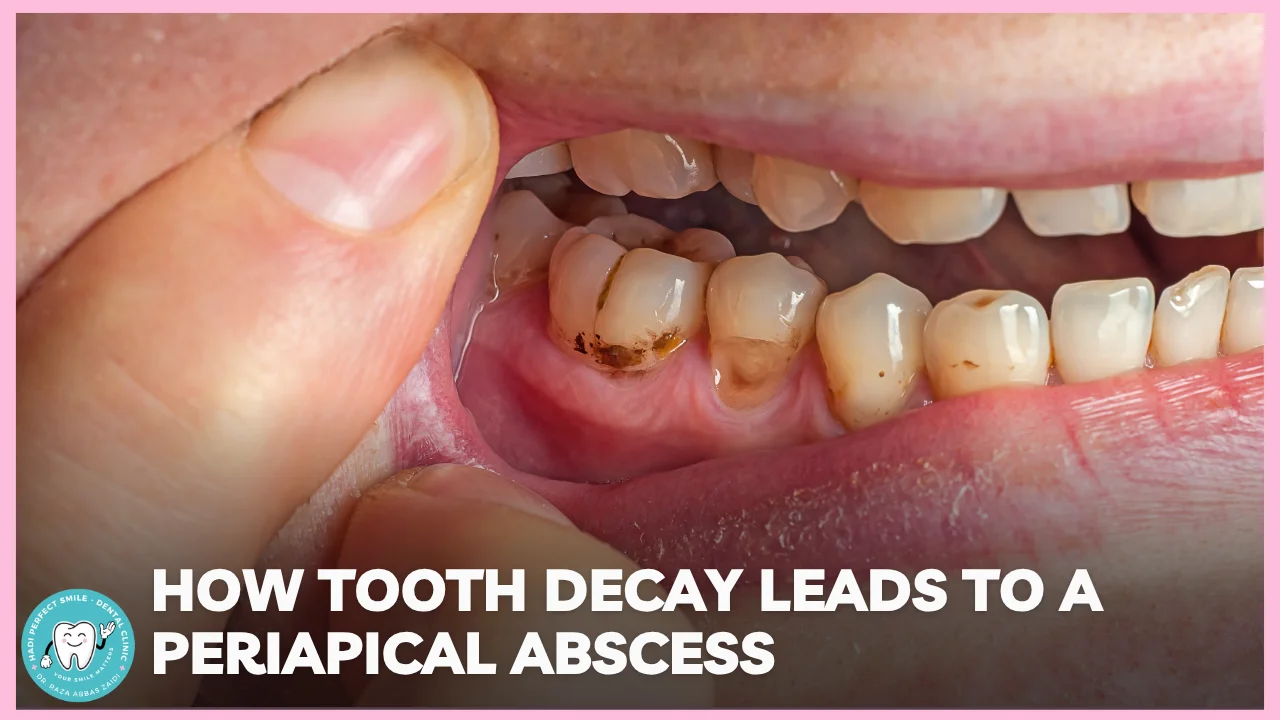
How Tooth Decay Leads to a Periapical Abscess
Most people think of tooth decay as a small cavity that only causes occasional sensitivity or discomfort. However, when left untreated, tooth decay can progress much deeper into the tooth and lead to serious complications. One of the most severe consequences of untreated decay is a periapical abscess, a painful infection that develops at the tip of a tooth root.
Understanding how tooth decay leads to a periapical abscess is important because early intervention can prevent severe pain, swelling, tooth loss, and potentially dangerous infections. Many patients delay treatment because they assume a cavity is not a serious problem. Unfortunately, even a small cavity can become a major dental emergency if ignored for too long.
At Hadi Perfect Smile – Dental Clinic, we frequently educate patients about the importance of treating cavities early. Under the expert care of Dr. Raza Abbas Zaidi (Dentist & Dental Surgeon), we focus on preventive dentistry, early diagnosis, and effective treatment to help patients maintain healthy smiles.
In this blog, we will explore how tooth decay develops, why it can lead to a periapical abscess, the symptoms to watch for, available treatment options, and how to prevent this painful condition.
What Is Tooth Decay?
Tooth decay, also known as dental caries or cavities, is the gradual destruction of tooth structure caused by bacteria. The mouth naturally contains bacteria that feed on sugars and carbohydrates from food and beverages.
As these bacteria digest food particles, they produce acids that attack the outer protective layer of the tooth, known as enamel. Repeated acid attacks weaken the enamel and eventually create small holes or cavities.
In the early stages, tooth decay may not cause any symptoms. However, if left untreated, it continues to progress deeper into the tooth.
Understanding the Structure of a Tooth
To understand how tooth decay leads to a periapical abscess, it helps to understand the structure of a tooth.
Each tooth consists of several layers:
Enamel
Enamel is the hard outer layer that protects the tooth from daily wear and bacterial attack. It is the strongest substance in the human body.
Dentin
Beneath the enamel lies dentin, a softer layer that contains microscopic tubules connected to the tooth’s nerve.
Pulp
The innermost part of the tooth is called the pulp. It contains blood vessels, nerves, and connective tissue that keep the tooth alive.
Root and Root Tip
The roots anchor the tooth within the jawbone. At the end of each root is the root tip, also known as the apex.
A periapical abscess develops around this root tip when infection spreads beyond the tooth.
The Journey from Tooth Decay to a Periapical Abscess
Many patients are surprised to learn that a cavity can eventually cause a severe infection. The progression usually occurs in several stages.
Stage 1: Initial Enamel Damage
The process begins when plaque bacteria produce acids that dissolve minerals from the enamel.
At this stage:
- White spots may appear on the tooth.
- No pain is usually present.
- The damage is often reversible with fluoride and proper care.
Without treatment, the decay continues deeper.
Stage 2: Decay Reaches the Dentin
Once decay breaks through the enamel, it enters the dentin.
Because dentin is softer than enamel, decay spreads more rapidly.
Patients may begin experiencing:
- Mild sensitivity.
- Pain when eating sweets.
- Discomfort with hot or cold foods.
This is often the stage when patients first notice a problem.
Stage 3: Infection Reaches the Pulp
As decay progresses, bacteria eventually reach the pulp chamber.
The pulp becomes inflamed, a condition known as pulpitis.
Symptoms may include:
- Severe toothache.
- Lingering sensitivity.
- Spontaneous pain.
- Difficulty sleeping due to discomfort.
At this point, the tooth is significantly infected.
Stage 4: Death of the Pulp
If the infection remains untreated, the pulp tissue begins to die.
Although some patients experience temporary pain relief, this does not mean the problem has resolved.
Instead, bacteria continue spreading deeper into the root canal system.
This stage marks a critical turning point where tooth decay leads to a periapical abscess.
Stage 5: Formation of a Periapical Abscess
As bacteria travel through the root canals, they exit through the root tip and infect the surrounding bone.
The body’s immune system responds by sending white blood cells to fight the infection.
This battle results in the formation of pus, creating a periapical abscess around the root tip.
At this stage, the infection can no longer be ignored and requires immediate dental care.
What Is a Periapical Abscess?
A periapical abscess is a pocket of pus that forms at the tip of a tooth root due to bacterial infection.
It is one of the most common dental emergencies and often causes severe pain and swelling.
Unlike gum infections that begin in the periodontal tissues, a periapical abscess originates inside the tooth and spreads outward.
The condition can affect both children and adults and often develops from untreated cavities.
Symptoms of a Periapical Abscess
Recognizing symptoms early can help prevent complications.
Common signs include:
Severe Toothache
The pain is often throbbing and persistent.
Many patients describe it as one of the most intense forms of dental pain.
Sensitivity to Temperature
Hot and cold foods may trigger prolonged discomfort.
Pain While Chewing
Pressure on the affected tooth can cause sharp pain.
Swelling
Swelling may occur around:
- The gums.
- The jaw.
- The cheek.
Bad Taste in the Mouth
Pus drainage can create an unpleasant taste.
Bad Breath
Bacterial infection often causes persistent bad breath.
Fever
A fever may indicate that the infection is spreading.
Swollen Lymph Nodes
The body’s immune response may cause swelling in the neck or under the jaw.
Why You Should Never Ignore a Periapical Abscess
A common misconception is that dental infections remain localized.
In reality, untreated abscesses can spread to surrounding tissues and beyond.
Potential complications include:
- Bone destruction.
- Tooth loss.
- Facial swelling.
- Jaw infections.
- Spread of infection to other parts of the body.
In severe cases, untreated dental infections can become life-threatening.
Prompt treatment is always essential.
How Dentists Diagnose a Periapical Abscess
At Hadi Perfect Smile Dental Clinic, diagnosis begins with a comprehensive examination.
The dentist evaluates:
- Symptoms.
- Tooth condition.
- Gum health.
- Swelling and tenderness.
Digital dental X-rays are used to confirm the presence of infection around the root tip.
X-rays help determine the extent of the damage and guide treatment planning.
Treatment Options for a Periapical Abscess
The primary goal of treatment is to eliminate infection and preserve the natural tooth whenever possible.
Root Canal Treatment
Root canal therapy is often the preferred treatment.
The procedure involves:
- Removing infected pulp tissue.
- Cleaning and disinfecting root canals.
- Sealing the tooth to prevent reinfection.
Root canal treatment allows patients to keep their natural teeth.
Abscess Drainage
In cases of significant swelling, the abscess may be drained to relieve pressure.
Antibiotic Therapy
Antibiotics may be prescribed if the infection has spread or if swelling is extensive.
Tooth Extraction
When a tooth is too severely damaged to save, extraction may be necessary.
After extraction, replacement options such as dental implants can be considered.
How to Prevent Tooth Decay and Periapical Abscesses
The best way to prevent a periapical abscess is to stop decay before it reaches the pulp.
Simple preventive measures include:
Brush Twice Daily
Use fluoride toothpaste and proper brushing techniques.
Floss Every Day
Flossing removes plaque from areas a toothbrush cannot reach.
Limit Sugary Foods and Drinks
Reducing sugar intake lowers the risk of cavities.
Visit Your Dentist Regularly
Routine checkups allow early detection and treatment of decay.
Treat Cavities Promptly
Small cavities are easier and less expensive to treat than advanced infections.
Why Choose Hadi Perfect Smile for Dental Infection Treatment?
At Hadi Perfect Smile – Dental Clinic, we provide comprehensive dental care focused on prevention, early diagnosis, and patient comfort.
Under Dr. Raza Abbas Zaidi, we offer:
- Digital dental imaging.
- Root canal treatments.
- Emergency dental care.
- Cavity treatment.
- Preventive dentistry.
- Personalized treatment planning.
Our mission is to help patients avoid serious dental complications and maintain healthy smiles.
Clinic Details
📍 Address:
J-3/100-A, J- Extension, Near Anar Wali Masjid, Laxmi Nagar, Delhi – 110092
📞 Call Us:
+91-7011690245
📧 Email:
contact@hadiperfectsmile.in
🌐 Website:
www.hadiperfectsmile.in
Final Thoughts
Understanding how Tooth Decay Leads to a Periapical Abscess can help patients recognize the importance of early dental care. What begins as a small cavity can gradually progress into a severe infection affecting the tooth root and surrounding bone.
The good news is that most periapical abscesses are preventable. Regular dental checkups, proper oral hygiene, and prompt treatment of cavities can significantly reduce the risk of infection.
At Hadi Perfect Smile Dental Clinic, we are committed to helping patients maintain healthy teeth through preventive care, early diagnosis, and advanced treatment solutions.
Your Smile Matters.